Treasury Announces Tax Cuts: Follow the Money.
Where will Australia's $268 tax cuts actually come from if the budget isn't balanced?

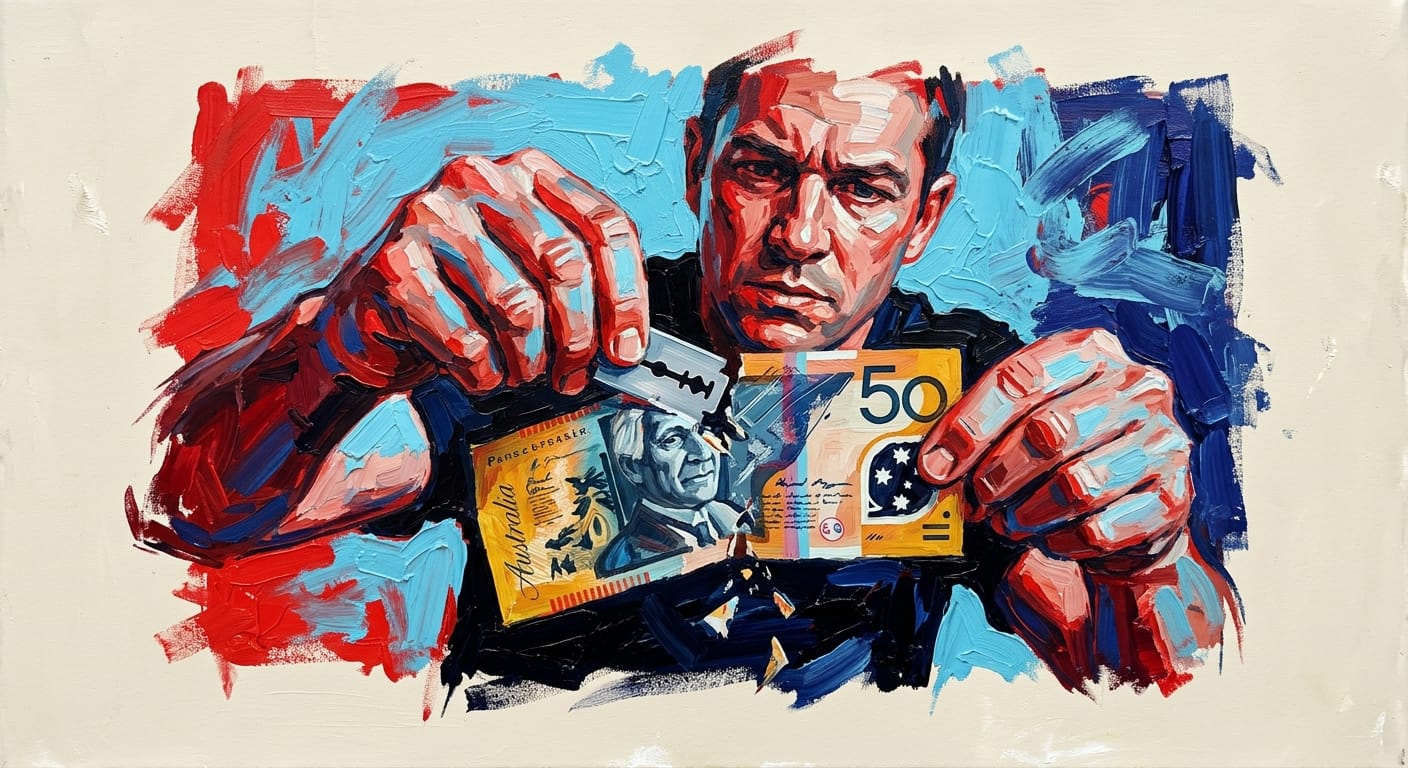
Treasury Announces Tax Cuts: Follow the Money
The Albanese government wants you to think about the $268 landing in your account on 1 July. What it would prefer you not think about is the budget it came from.
Bottom line: A tax cut that reduces revenue without a corresponding reduction in spending does not fix a structural deficit — it defers it. The cost gets paid later, either through higher taxes, reduced services, or borrowing that future governments inherit. Fourteen million Australians getting $268 richer this July does not change the arithmetic.
Treasurer Jim Chalmers announced this week that from 1 July, over 14 million taxpayers will receive a cut of up to $268, the latest in a series of reductions the government says will save the average worker up to $2,816 a year by 2027–28. The package is politically elegant: it is structured across five separate cuts, in three different forms, timed to land in successive financial years. Every announcement gets its own media cycle. Every July becomes a good-news day. The government notes that younger Australians — Gen Z and Millennials — make up roughly 60 per cent of recipients, which is useful framing given that demographic's well-documented financial stress.
None of that is insincere. The cuts are real money going to real people. The question the press release does not answer is: where does the money come from, and what happens to the structural forces that put the budget under pressure in the first place?
The budget's problem is spending composition, not revenue
Australia's federal budget is not, at its core, a revenue problem. It is a spending composition problem. The major cost pressures — aged care, the NDIS, health, defence, debt servicing — are all growing faster than the economy. The NDIS alone has tracked well above its original cost projections for years, with government after government adjusting the forecasts upward and hoping the next round of reforms will bend the curve. They have not, so far, bent it.
This matters because of how revenue projections work. When Treasury models the impact of tax cuts, it is estimating the static loss: if the rate goes down, this much less comes in. What those models are slower to capture is the behavioural dynamic on the spending side. Demand-side fiscal commitments — payments, offsets, subsidies — tend to expand once established. The political economy of removing them is brutal. The political economy of adding to them is easy. So you end up with governments that cut taxes in good revenue years and find, when the cycle turns, that spending has not followed revenue down.
The political economy of removing them is brutal. The political economy of adding to them is easy.
The $1,000 instant deduction costs more than its headline figure
The $1,000 instant tax deduction announced as part of this package is a good illustration of the principle. It is a simple, popular measure. It will also reward people with legitimate work expenses — and create incentives for others to find expenses they would not otherwise have claimed. Deductions of this kind are notoriously difficult to audit at scale. The revenue cost is not just the headline figure; it includes the behavioural response the headline figure was not designed to account for. Treasury's own Tax Expenditures Statement documents how significantly these add up across the system.
The government's political defence is straightforward enough: the Coalition voted against the new cuts. This is true. It is also largely irrelevant to the structural question. Opposition is not the same as offering a fiscally coherent alternative, and the fact that one party wanted higher taxes does not mean the other party's position is fiscally responsible. Both claims can be true simultaneously.
Five stacked cuts land when the fiscal cycle is not guaranteed to hold
What makes this particular moment worth examining carefully is the scale of the commitment. The government is not announcing one tax cut. It is announcing five, stacked across three years, with a working offset embedded on top. Each layer is individually modest. Cumulatively, they represent a significant reduction in the revenue base at a time when the spending obligations on the other side of the ledger are not shrinking. The fiscal position Australia currently enjoys — the terms of trade, the employment numbers, the commodity cycle — is not guaranteed to persist. It rarely does.
A tax cut is not inherently bad policy. Returning bracket creep to workers is reasonable. Reducing the tax burden on lower and middle incomes has real distributional merit. But a tax cut announced without a credible account of which spending growth it is matched against is not a fiscal plan. It is a political event. The $268 is real. The structural imbalance that produced the deficit conditions it is being cut from is also real. Only one of those two things is getting a press release.
Sources
Treasury Ministers — More tax cuts in one month from today
Australian Treasury — Tax Expenditures and Insights Statement
Australian Treasury — Budget 2025–26 Overview
Australian Institute of Health and Welfare — NDIS Quarterly Report
Frequently Asked Questions
Why doesn't a tax cut fix Australia's budget deficit?
A tax cut reduces government revenue without automatically reducing spending, which means the deficit gap either widens or gets deferred. Australia's budget pressure comes primarily from spending obligations — the NDIS, aged care, health, debt servicing — that are growing faster than the economy and are politically difficult to reduce.
How much will Australians actually save from the 2025 tax cuts?
From 1 July, over 14 million taxpayers will receive a cut of up to $268. The government says cumulative cuts will save the average worker up to $2,816 a year by 2027–28, though that ceiling figure applies to a subset of recipients and the majority will receive less.
What is the $1,000 instant tax deduction and who does it benefit?
The $1,000 instant deduction allows workers to claim up to $1,000 in work-related expenses without receipts. It simplifies the claims process but also creates incentives to claim expenses that would not otherwise have been claimed, making the true revenue cost higher than the headline figure suggests.
Why does the government announce tax cuts in stages rather than all at once?
The Albanese government structured its package as five separate cuts across three financial years, which means each instalment generates its own media cycle and each July produces a fresh good-news announcement. The article describes this as 'politically elegant' — the cumulative commitment is larger than any single announcement makes it appear.
Does it matter that the Coalition opposed the tax cuts?
Not to the structural fiscal question. Opposition to a policy is not the same as offering a fiscally coherent alternative. The argument that cutting taxes without matching spending reductions defers a deficit applies regardless of which party is in government or how the other party votes.